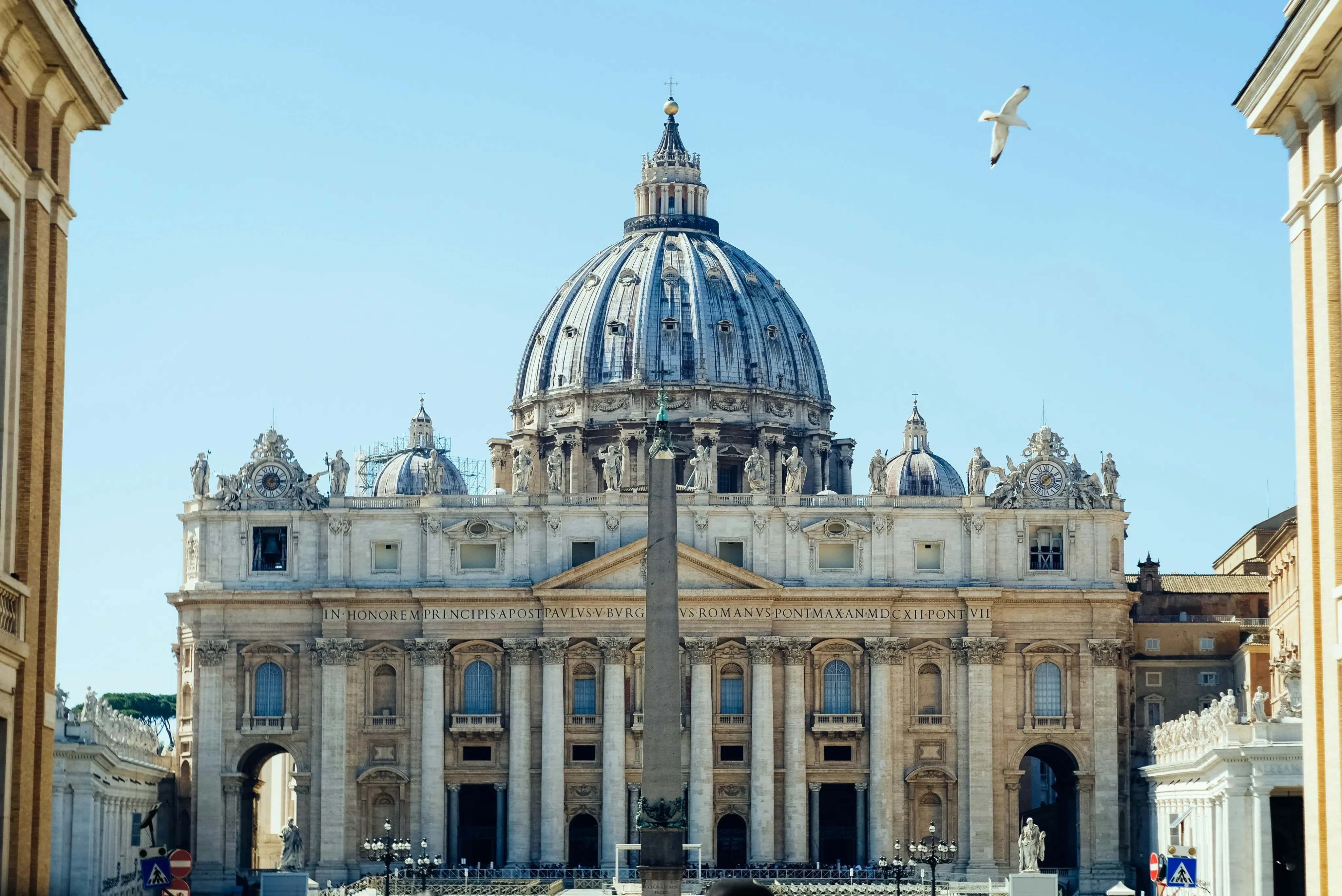
St. Peter's Basilica
Introduction
St. Peter's Basilica (Italian: Basilica di San Pietro; Latin: Basilica Sancti Petri) is a renowned Renaissance church located in Vatican City, the papal enclave within Rome, Italy. It is one of the largest churches in the world and arguably the most famous work of Renaissance architecture, symbolizing the heart of the Catholic Church.[1][2]
Designed principally by Donato Bramante, Michelangelo Buonarroti, Carlo Maderno, and Gian Lorenzo Bernini, St. Peter's stands above the traditional burial site of Saint Peter, one of Jesus Christ's twelve apostles and the first Bishop of Rome (Pope). The basilica is regarded as one of the holiest Catholic shrines and holds a unique position in the Christian world as a major pilgrimage destination.[1][3]
Historical Background
Old St. Peter's Basilica
The history of St. Peter's begins in the 4th century when Emperor Constantine I initiated construction of a basilica around 324 CE over what was believed to be the burial site of Saint Peter, martyred in Rome around 64-68 CE during Nero's persecution of Christians. Old St. Peter's was completed around 354 CE by Constantine's son, Constantius II, and served as a major pilgrimage site for over 1,000 years.[4][5]
By the late 15th century, Old St. Peter's was in a state of severe disrepair, with structural problems threatening its stability. Pope Nicholas V began modest repairs in the 1450s, but the decision to completely rebuild the basilica came under Pope Julius II in 1505.[5]
Renaissance Construction (1506-1626)
The construction of the new St. Peter's Basilica spanned 120 years and involved contributions from the greatest artists and architects of the Renaissance:[1][6]
Donato Bramante (1506-1514): Pope Julius II appointed Bramante as chief architect. Bramante designed a Greek cross plan (equal-length arms) topped by a massive central dome inspired by the ancient Pantheon. Construction began on April 18, 1506, with the demolition of Old St. Peter's and the laying of the new foundation.[2][6]
Subsequent architects (1514-1546): After Bramante's death, Raphael Sanzio, Fra Giocondo, and Antonio da Sangallo the Younger served as chief architects, with each making modifications to the original design.[7]
Michelangelo (1546-1564): At age 71, Michelangelo was appointed chief architect by Pope Paul III. He simplified Bramante's design, strengthened the structure, and redesigned the dome. Although he died before the dome's completion, his design was largely followed by his successors. The iconic dome, completed in 1590, rises to 136.6 meters (448 feet) and remains one of the largest domes in the world.[1][2][6]
Carlo Maderno (1603-1629): Pope Paul V commissioned Maderno to extend the nave eastward, transforming the Greek cross into a Latin cross (with a longer nave). This change accommodated larger congregations and aligned the basilica with traditional church layouts. Maderno also designed the façade, completed in 1614.[1][6]
Gian Lorenzo Bernini (1629-1667): Bernini, the great Baroque artist, made the final major contributions. He designed the magnificent bronze baldachin (canopy) over the papal altar and created the grand St. Peter's Square with its iconic colonnades, completed in 1667. The square can accommodate over 300,000 people.[1][2]
The basilica was consecrated on November 18, 1626, exactly 1,300 years after the consecration of Old St. Peter's.[2]
Architectural Features
Dimensions and Scale
St. Peter's Basilica is one of the largest churches ever built:
Interior length: 186.36 meters (611.5 feet)
Interior height of nave: 46 meters (151 feet)
Height to top of dome: 136.6 meters (448 feet)
Dome diameter: 42 meters (138 feet) interior diameter
Total area: Approximately 15,160 square meters (163,000 square feet)
The Dome
Michelangelo's dome is the basilica's most distinctive feature. The double-shell dome features:
Design inspiration: Based on Brunelleschi's dome for Florence Cathedral and the ancient Pantheon
Structure: Ribbed dome with 16 ribs visible from the exterior
Lantern: A decorative lantern at the summit
Inscription: Around the interior base runs the Latin inscription: "TV ES PETRVS ET SVPER HANC PETRAM AEDIFICABO ECCLESIAM MEAM" ("You are Peter, and upon this rock I will build my church" - Matthew 16:18)[1][6]
Visitors can climb 551 steps to the top of the dome for panoramic views of Rome and Vatican City.[1]
Interior Artworks
St. Peter's contains extraordinary artistic treasures:
Michelangelo's Pietà (1498-1499): The famous marble sculpture depicting Mary holding the dead body of Jesus, located in the first chapel on the right. This is the only work Michelangelo ever signed.[1][2]
Bernini's Baldachin (1623-1634): A massive bronze canopy, 29 meters (95 feet) high, over the papal altar, marking the tomb of St. Peter below. It required melting down bronze from the Pantheon's portico.[1]
St. Peter's Throne (Cathedra Petri): Bernini's elaborate bronze throne in the apse, surrounded by sculptures of Church Fathers and topped by a golden glory with the dove of the Holy Spirit.[1]
Numerous chapels, altars, and monuments: Including papal tombs, mosaics, paintings, and sculptures by renowned artists.[3]
St. Peter's Square
Bernini's St. Peter's Square (Piazza San Pietro) is an architectural masterpiece:
Colonnades: Two semicircular colonnades with 284 columns in four rows, topped by 140 statues of saints
Obelisk: A 25-meter Egyptian obelisk brought to Rome by Emperor Caligula, erected in the square in 1586
Symbolism: The colonnades represent the Church's embrace of humanity, with the square serving as a gathering place for pilgrims from around the world[1][2]
Cultural and Religious Significance
St. Peter's Basilica is the spiritual center of Catholicism and one of the most significant churches in Christendom. It serves multiple functions:[1][3]
Papal basilica: The Pope presides over major liturgical celebrations here
Pilgrimage destination: Millions of pilgrims visit annually, particularly during Holy Years
Architectural influence: The basilica has profoundly influenced church architecture worldwide, serving as a model for countless buildings
Artistic repository: Houses some of the greatest masterpieces of Renaissance and Baroque art
The basilica represents the pinnacle of Renaissance architectural achievement and embodies the Catholic Church's artistic and spiritual aspirations. Its construction involved the collaboration of history's greatest artists and architects over more than a century, resulting in a monument that continues to inspire awe and devotion.[1][6]
Today, St. Peter's remains one of the most visited sites in the world, welcoming pilgrims and tourists who come to experience its spiritual significance, architectural grandeur, and artistic treasures.[3]
References
[1]: Britannica. "St. Peter's Basilica." <566> (Accessed December 2025)
[2]: Wikipedia. "St. Peter's Basilica." <567> (Accessed December 2025)
[5]: Encyclopedia.com. "St. Peter's Basilica." <568> (Accessed December 2025)
[3]: Italy Magazine. "Monument: St. Peter's Basilica." <569> (Accessed December 2025)
[6]: Smarthistory. "Saint Peter's Basilica." <570> (Accessed December 2025)
[4]: Britannica. "Old Saint Peter's Basilica." <571> (Accessed December 2025)
[7]: Human LibreTexts. "Saint Peter's Basilica." <572> (Accessed December 2025)