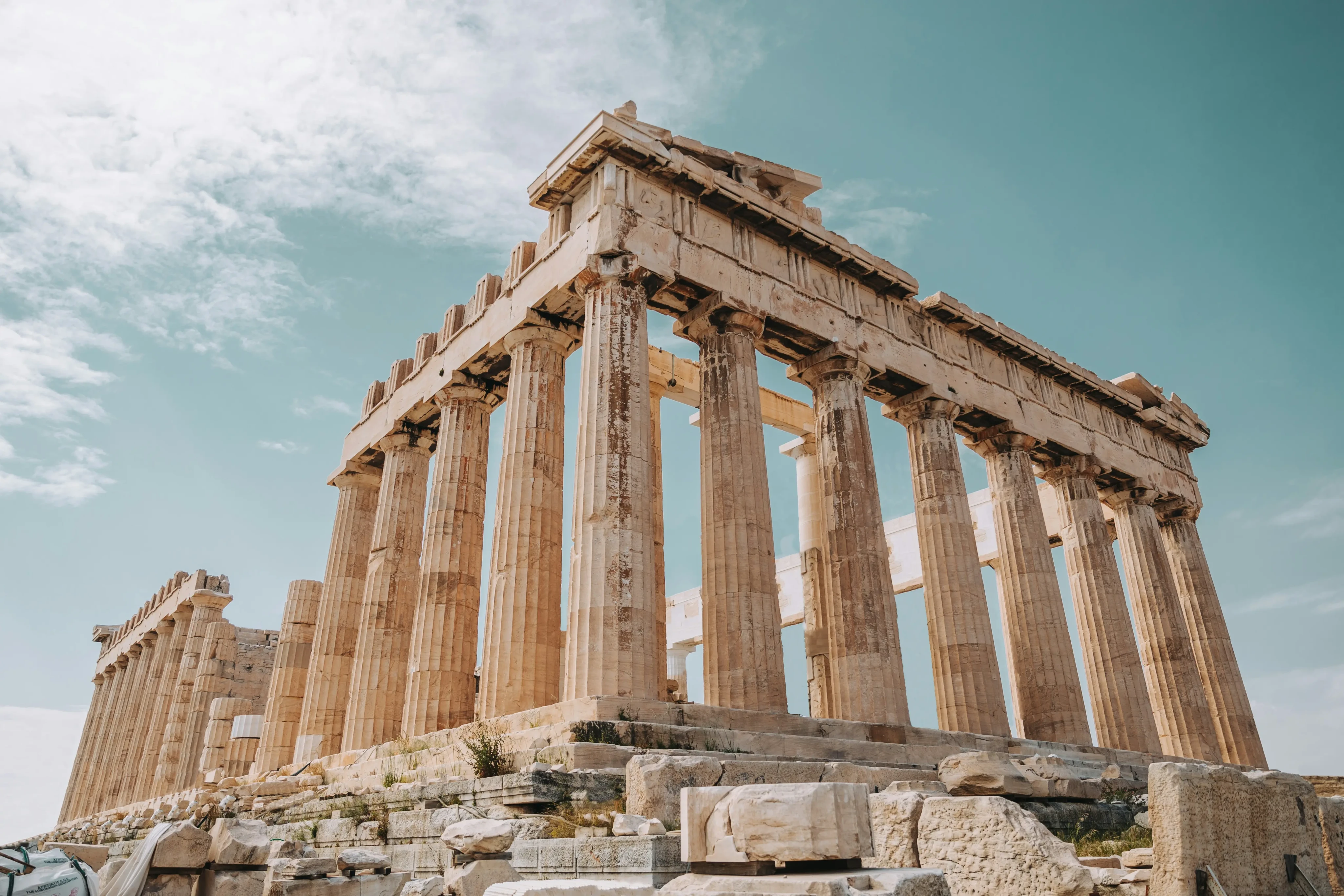
Parthenon
Introduction
The Parthenon is an ancient Greek temple dedicated to the goddess Athena, located on the Acropolis in Athens, Greece. Built between 447 and 432 BCE during the height of the Athenian Empire, it is widely considered the finest example of classical Greek architecture and one of the most iconic buildings in human history.[1][2]
The Parthenon, along with the Acropolis of Athens, was designated a UNESCO World Heritage Site in 1987, recognizing its outstanding universal value as a masterpiece of human creative genius and its profound influence on art and architecture throughout history.[3]
Historical Background
Construction and Classical Athens
The current Parthenon is actually the third temple dedicated to Athena built on this site. Construction began in 447 BCE under the leadership of Pericles, the prominent Athenian statesman, during Athens' Golden Age. The temple was designed by the architects Ictinus and Callicrates, with the sculptor Phidias overseeing the artistic program.[1][4]
The Parthenon was built using white marble quarried from Mount Pentelicus, located approximately 16 kilometers from Athens. The construction took nine years to complete the main structure, with the decorative sculptures finished by 432 BCE. The project required enormous resources and demonstrated Athens' wealth and power following victory in the Persian Wars.[4][5]
Purpose and Function
The Parthenon served multiple purposes:
Religious sanctuary: Housed a massive chryselephantine (gold and ivory) statue of Athena Parthenos, approximately 12 meters tall, created by Phidias
Treasury: Stored the Athenian League's treasury and valuable offerings to the goddess
Symbol of power: Demonstrated Athenian supremacy and cultural achievement[1][5]
Later History
Throughout its 2,400+ year history, the Parthenon has survived numerous transformations:
5th century CE: Converted into a Christian church dedicated to the Virgin Mary
1460s: Transformed into a mosque following Ottoman conquest of Athens
1687: Severely damaged when Venetian forces bombarded the Acropolis, causing an explosion that destroyed much of the structure (the Ottomans had been using it as a gunpowder magazine)
Early 1800s: Lord Elgin removed many sculptures (now known as the Elgin Marbles) and transported them to Britain, where they remain in the British Museum
1975–present: Ongoing restoration and conservation efforts[1][2][4]
Architectural Features
Structural Design
The Parthenon is a Doric peripteral temple, meaning it features a rectangular floor plan surrounded by columns on all four sides. The temple measures approximately:
Length: 69.5 meters (228 feet)
Width: 30.9 meters (101 feet)
The temple features 8 columns on each short end and 17 columns along each long side, creating a total of 46 outer columns. The columns are in the Doric order, characterized by simple capitals and no bases.[6]
Optical Refinements
What makes the Parthenon truly remarkable are its subtle optical refinements, designed to correct visual distortions and create an appearance of perfect proportion:
Curved horizontal lines: The stylobate (platform) and entablature curve upward slightly at the center to prevent the appearance of sagging
Column entasis: The columns swell slightly in the middle and taper at the top to correct the optical illusion of concavity
Inclined columns: All columns lean slightly inward to enhance the building's sense of solidity
Varied column spacing: Corner columns are slightly thicker and closer together to compensate for the bright background sky[4][1]
These refinements demonstrate the ancient Greeks' sophisticated understanding of geometry and optics, creating a structure that appears perfectly straight and proportioned to the human eye despite being composed of subtle curves and angles.[4]
Sculptural Decoration
The Parthenon originally featured three types of sculptural decoration:
Pediments: Large triangular gables at each end filled with sculpture depicting mythological scenes (east: birth of Athena; west: contest between Athena and Poseidon)
Metopes: 92 square relief panels depicting various mythological battles
Frieze: A 160-meter continuous relief sculpture depicting the Panathenaic procession, a major Athenian religious festival[1][5]
Much of this sculpture is now housed in museums, including the British Museum (Elgin Marbles) and the Acropolis Museum in Athens.[1]
Cultural Significance
The Parthenon stands as the ultimate expression of classical Greek architecture and represents the pinnacle of the Doric order. Its harmonious proportions, mathematical precision, and innovative optical refinements have influenced architectural design for over two millennia.[4]
The temple symbolizes the birth of Western civilization, democracy, and the pursuit of rational thought and artistic excellence. It remains a powerful icon of ancient Greece's cultural achievements and continues to inspire architects, artists, and scholars worldwide.[1][3]
Despite suffering significant damage from warfare, natural disasters, and human intervention over the centuries, the Parthenon endures as one of the world's most recognizable and influential buildings, dominating the Athens skyline for 2,500 years.[4]
References
[1]: Britannica. "Parthenon | Definition, History, Architecture, Columns, Greece, & Facts." <https://www.britannica.com/topic/Parthenon> (Accessed December 2025)
[2]: Wikipedia. "Parthenon." <https://en.wikipedia.org/wiki/Parthenon> (Accessed December 2025)
[4]: History.com. "How the Ancient Greeks Designed the Parthenon to Impress—And Last." <https://www.history.com/articles/parthenon-acropolis-ancient-greece-engineering> (July 2019)
[5]: Acropolis Tickets. "Acropolis Parthenon in Athens | History & Visitor Guide." <https://acropolis-tickets.com/acropolis-parthenon-greece> (Accessed December 2025)
[6]: AcropolisofAthens.gr. "Facts." <https://www.acropolisofathens.gr/facts-info/facts> (Accessed December 2025)
[3]: Visit Greece. "Acropolis of Athens." <https://www.visitgreece.gr/experiences/culture/archaeological-sites-and-monuments/acropolis-of-athens/> (Accessed December 2025)