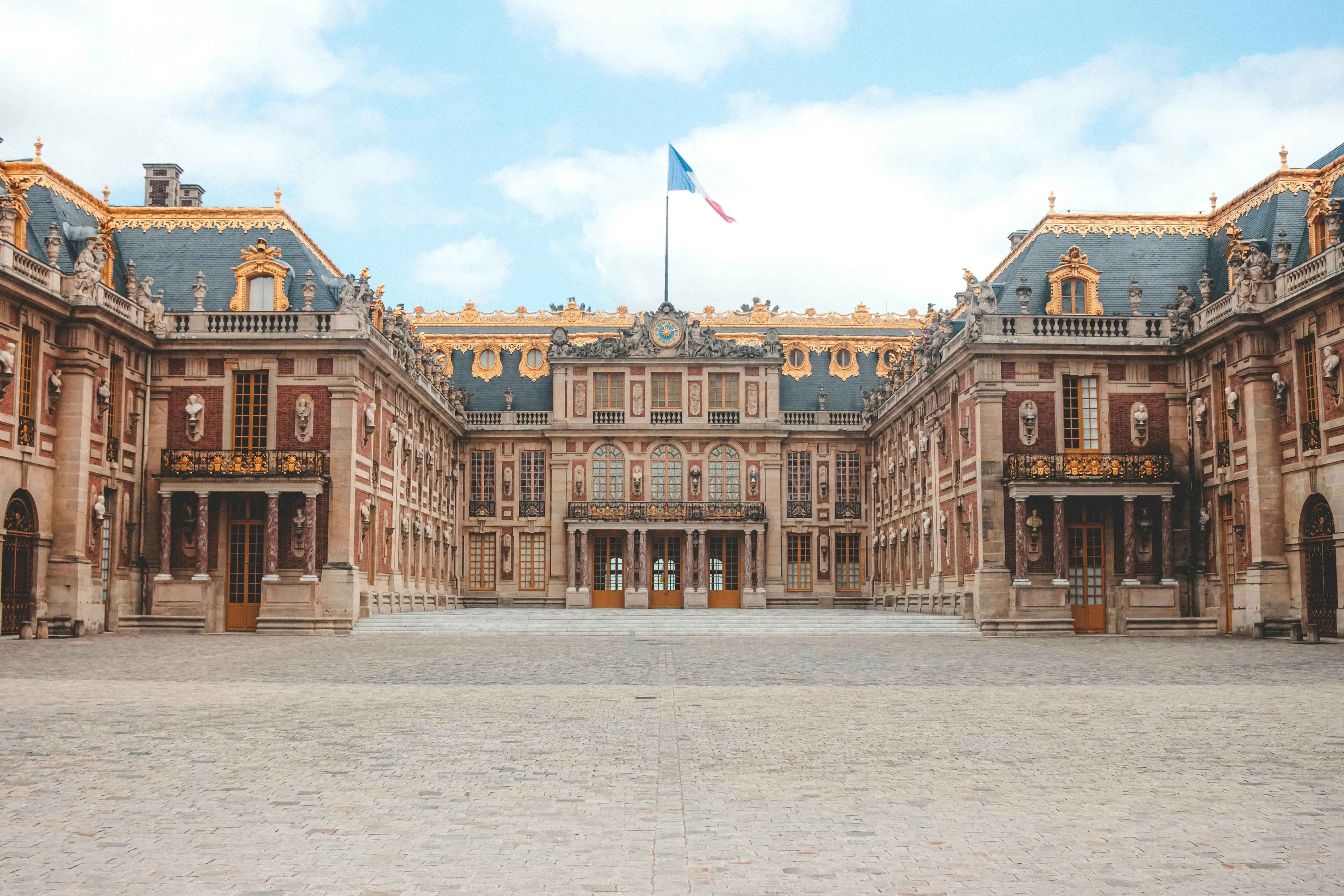
Palace of Versailles
Introduction
The Palace of Versailles (French: Château de Versailles) is a former royal residence and one of the most magnificent examples of French Baroque architecture. Located in Versailles, approximately 20 kilometers southwest of Paris, it served as the principal royal residence and the center of political power in France from 1682, when King Louis XIV moved from Paris, until the royal family was forced to return to the capital during the French Revolution in 1789.[1][2]
In 1979, UNESCO designated the Palace and Park of Versailles as a World Heritage Site, recognizing it as a symbol of the system of absolute monarchy and its influence on European palatial architecture.[3]
Historical Background
Origins
The site originally began as a modest hunting lodge built by King Louis XIII in 1623. The king enjoyed hunting in the forests surrounding Versailles and wanted a convenient place to stay. This small château was the precursor to what would become one of the world's most opulent palaces.[1][4]
Louis XIV's Grand Vision
King Louis XIV, known as the "Sun King," transformed the hunting lodge into a magnificent palace complex beginning in 1661. His vision was to create a symbol of absolute royal power and to move the court away from Paris, where he felt vulnerable after experiencing civil unrest during his youth.[1][2]
The major construction took place in four campaigns between 1664 and 1710, involving thousands of workers and the era's finest architects, artists, and landscape designers. On May 6, 1682, Louis XIV officially moved the royal court and government to Versailles, making it the center of political power in France for over a century.[2]
Royal Residence and Political Center
For more than 100 years, Versailles functioned as the residence of French kings and the seat of French government. Louis XIV's successors, Louis XV and Louis XVI, continued to embellish the palace, adding new apartments, theaters, and decorative elements. The palace served as the primary royal residence until October 6, 1789, when the royal family was forced to return to Paris during the French Revolution.[1][3]
Modern Era
In 1837, King Louis-Philippe converted the palace into a museum dedicated to "all the glories of France." During this transformation, he preserved the most significant royal apartments while adapting other spaces to display paintings and sculptures celebrating French history.[1]
Today, the Palace of Versailles is one of the most visited monuments in France, attracting millions of visitors annually who come to admire its architectural splendor, artistic treasures, and magnificent gardens.[5]
Architectural Features
The Palace Complex
The palace covers approximately 63,154 square meters (679,784 square feet) with 2,300 rooms. The main palace building stretches 680 meters across, creating an imposing façade that reflects the grandeur of the French monarchy.[1]
Hall of Mirrors
The most famous room in the palace is the Hall of Mirrors (Galerie des Glaces), completed in 1684. This spectacular gallery measures 73 meters (240 feet) in length and features 357 mirrors arranged in 17 arched mirror-clad niches that reflect the windows overlooking the gardens. The ceiling is adorned with paintings by Charles Le Brun depicting the glories of Louis XIV's reign.[1][5]
The Hall of Mirrors served as a passage between the king's and queen's apartments and was used for court ceremonies and receptions. It also played a significant role in history as the location where the Treaty of Versailles was signed in 1919, ending World War I.[1]
Royal Apartments
The palace contains elaborate royal apartments, including:
The King's Grand Apartment: Seven salons dedicated to different Roman gods, showcasing paintings, sculptures, and decorative arts
The Queen's Apartment: Lavishly decorated chambers where two queens of France (Maria Theresa and Marie-Antoinette) and two dauphines lived
The Royal Chapel: A two-story chapel with ornate decorations where the royal family attended daily mass[5]
The Gardens
The Gardens of Versailles, designed by André Le Nôtre, cover approximately 800 hectares (1,977 acres). These meticulously designed French formal gardens feature geometric patterns, ornate fountains, sculptures, and perfectly manicured hedges and trees. The gardens include the Grand Canal, numerous fountains with mythological themes, and the Orangery, which houses over 1,000 trees including orange, lemon, and pomegranate trees.[1][3]
The Estate
Beyond the main palace and gardens, the estate includes:
The Grand Trianon: A smaller palace built by Louis XIV as a retreat from court life
The Petit Trianon: Built by Louis XV and later associated with Marie-Antoinette
The Hameau de la Reine: Marie-Antoinette's rustic hamlet, featuring a mock Norman village with farms and cottages[5]
Cultural Significance
The Palace of Versailles represents the pinnacle of French 17th-century art and architecture. It embodies the concept of absolute monarchy, where all aspects of life revolved around the king, and served as a model for royal and princely residences throughout Europe.[3]
The palace has profoundly influenced architectural culture across Europe and beyond. Numerous palaces were inspired by Versailles, including the Royal Palace of Madrid, Schönbrunn Palace in Vienna, and Peterhof Palace in Russia. Its gardens established the standard for French formal garden design that was emulated worldwide.[3][1]
Today, Versailles stands not only as a monument to royal grandeur but also as a testament to the artistic and architectural achievements of 17th and 18th century France, continuing to inspire visitors from around the world.[5]
References
[1]: Britannica. "Palace of Versailles." <https://www.britannica.com/topic/Palace-of-Versailles> (Accessed December 2025)
[5]: Château de Versailles. "The Palace." <https://en.chateauversailles.fr/discover/estate/palace> (Accessed December 2025)
[2]: Wikipedia. "History of the Palace of Versailles." <https://en.wikipedia.org/wiki/History_of_the_Palace_of_Versailles> (Accessed December 2025)
[3]: UNESCO World Heritage Centre. "Palace and Park of Versailles." <https://whc.unesco.org/en/list/83/video> (Accessed December 2025)
[4]: Versailles Tourisme. "Palace of Versailles." <https://en.versailles-tourisme.com/palace-of-versailles.html> (Accessed December 2025)