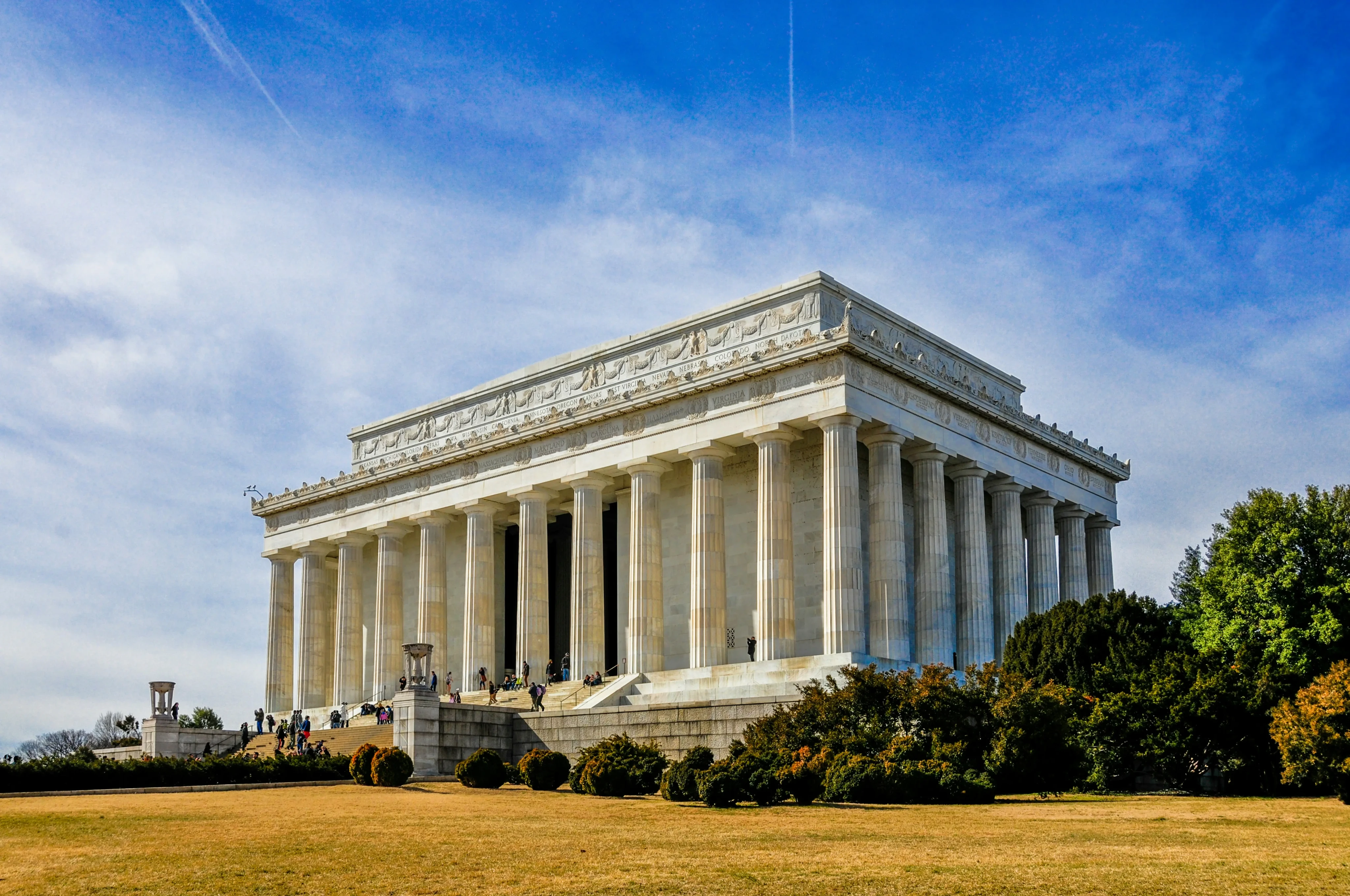
Lincoln Memorial
Introduction
The Lincoln Memorial is a monumental tribute to Abraham Lincoln, the 16th President of the United States, located on the National Mall in Washington, D.C. Dedicated on May 30, 1922, this iconic neoclassical structure honors Lincoln's legacy of preserving the Union during the Civil War and his role in abolishing slavery.[1][2]
The memorial has become one of America's most powerful symbols of unity, democracy, and civil rights. It is listed on the National Register of Historic Places and serves as a focal point for national gatherings and historic events.[3]
Historical Background
Planning and Design
Plans for a memorial to Abraham Lincoln began shortly after his assassination in 1865, but it took decades for the project to gain momentum. In 1911, Congress approved the site at the western end of the National Mall, and a design competition was held.[2][4]
Architect Henry Bacon won the commission with his design inspired by ancient Greek temples, specifically the Parthenon. Bacon chose the classical Greek architectural style to symbolize the democratic ideals that Lincoln fought to preserve. The temple form also represented the immortality of Lincoln's principles and legacy.[5][4]
Construction
Construction began on February 12, 1914 (Lincoln's 105th birthday) and took eight years to complete. The project involved:
Materials: Construction used Indiana limestone, Colorado Yule marble, pink Tennessee marble, and Georgia marble
Labor: Hundreds of workers participated in the construction
Cost: Approximately $3 million (equivalent to over $50 million today)[1][6]
The memorial was dedicated on Memorial Day, May 30, 1922, in a ceremony attended by approximately 50,000 people. President Warren G. Harding presided over the dedication, and Robert Moton, president of Tuskegee Institute, delivered an address.[4]
Historic Events
The Lincoln Memorial has served as the backdrop for numerous significant moments in American history:
1939: Marian Anderson's historic concert after being denied access to Constitution Hall because of her race
1963: Dr. Martin Luther King Jr. delivered his famous "I Have a Dream" speech on the memorial steps during the March on Washington for Jobs and Freedom
Various protests and gatherings: The memorial has been the site of countless civil rights demonstrations, anti-war protests, and national celebrations[1][6]
Architectural Features
Overall Design
The Lincoln Memorial is designed as a Greek Doric temple with 36 exterior columns, representing the 36 states in the Union at the time of Lincoln's death. The structure measures:
Length: 57.8 meters (190 feet)
Width: 36.1 meters (118.5 feet)
The temple sits on a series of platforms, with 87 steps leading from the Reflecting Pool to the main entrance, creating a dramatic approach that emphasizes the monument's grandeur and dignity.[5]
The Lincoln Statue
The centerpiece of the memorial is the massive statue of Abraham Lincoln, created by renowned sculptor Daniel Chester French. The sculpture depicts Lincoln seated in contemplation, and it remains one of the most recognizable presidential statues in the world.[3][2]
Key features of the statue:
Height: 5.8 meters (19 feet) tall
Material: Carved from 28 blocks of white Georgia marble
Weight: Approximately 175 tons
Symbolism: Lincoln's hands rest on fasces (Roman symbols of authority), with his left hand clenched (representing his strength and determination) and his right hand open (symbolizing his compassion and willingness to extend mercy)[3][1]
Interior Chambers
The memorial's interior is divided into three chambers:
Central chamber: Contains the Lincoln statue
North chamber: Features Lincoln's Second Inaugural Address inscribed on the wall, with a mural by Jules Guerin titled "Reunion" depicting the angel of truth freeing a slave
South chamber: Displays the Gettysburg Address inscribed on the wall, with Guerin's mural "Emancipation" showing the angel of truth freeing slaves[3][2]
Above the statue, an inscription reads: "IN THIS TEMPLE / AS IN THE HEARTS OF THE PEOPLE / FOR WHOM HE SAVED THE UNION / THE MEMORY OF ABRAHAM LINCOLN / IS ENSHRINED FOREVER"[3]
The Reflecting Pool
In front of the memorial lies the Lincoln Memorial Reflecting Pool, completed in 1922. The pool measures 618.5 meters (2,029 feet) in length and creates a stunning mirror image of the memorial and the Washington Monument, symbolically linking the memorial to the broader National Mall.[5]
Cultural Significance
The Lincoln Memorial has transcended its original purpose as a tribute to a president to become a symbol of American democracy, freedom, and equality. Its location on the National Mall and its architectural grandeur make it one of the most visited monuments in the United States, attracting millions of visitors annually.[7]
The memorial's association with the civil rights movement, particularly through Dr. King's "I Have a Dream" speech, has reinforced its significance as a symbol of the ongoing struggle for equality and justice. It serves as a reminder of Lincoln's vision for a united nation and the continuing work needed to fulfill the promises of freedom and equality for all Americans.[6][4]
The memorial continues to inspire visitors from around the world, standing as a testament to Lincoln's enduring legacy and the democratic ideals he fought to preserve.[7]
References
[1]: Wikipedia. "Lincoln Memorial." <543> (Accessed December 2025)
[2]: Britannica. "Lincoln Memorial | History & Facts." <544> (Accessed December 2025)
[3]: National Park Service. "Memorial Features - Lincoln Memorial." <545> (Accessed December 2025)
[5]: SAH Archipedia. "Lincoln Memorial." <546> (Accessed December 2025)
[4]: National Geographic. "The surprising history behind the Lincoln Memorial." <547> (May 2022)
[6]: National Park Service. "History & Culture - Lincoln Memorial." <548> (Accessed December 2025)
[7]: National Park Service. "Lincoln Memorial." <549> (Accessed December 2025)