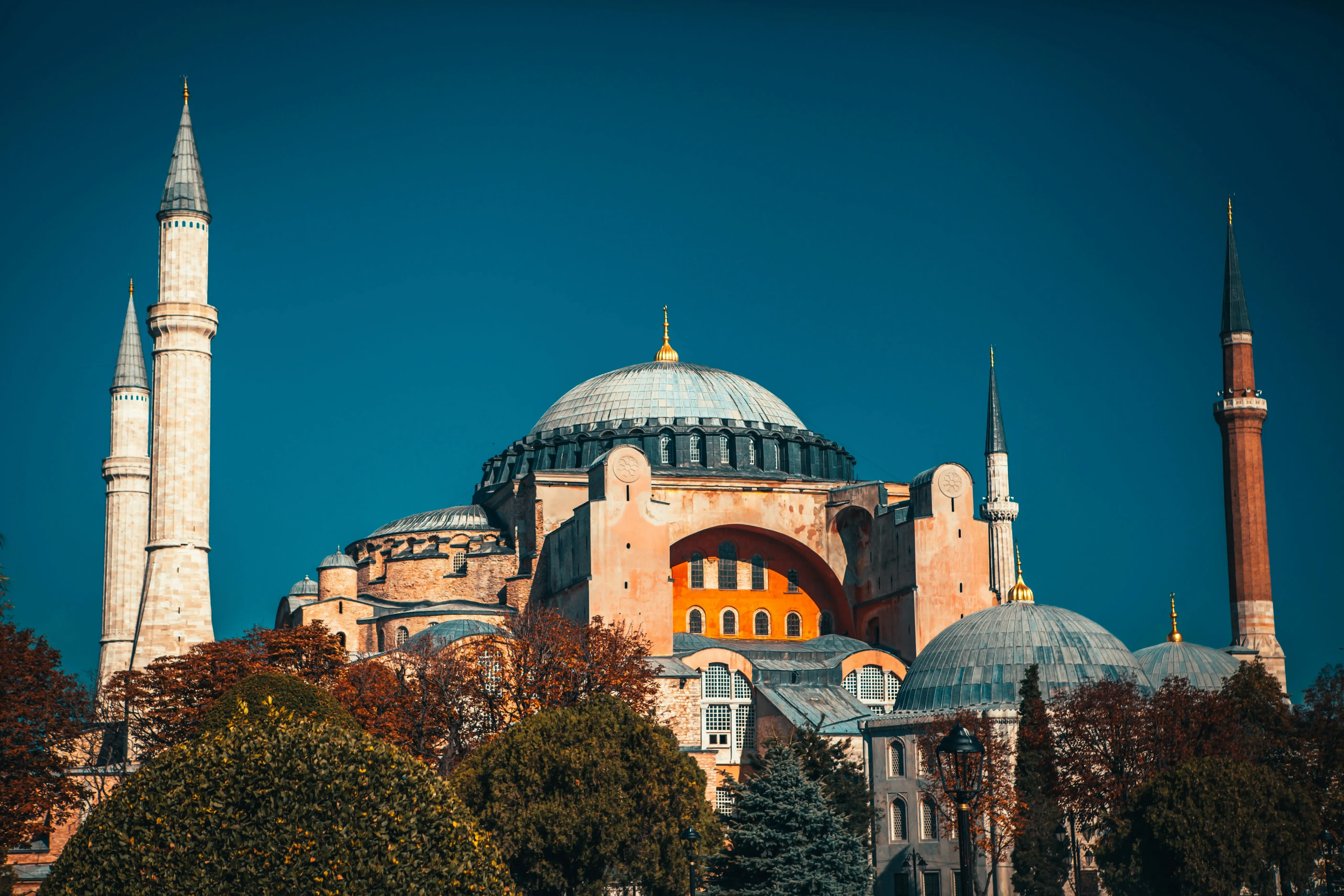
Hagia Sophia
Introduction
Hagia Sophia (Turkish: Ayasofya; Greek: Ἁγία Σοφία, "Holy Wisdom") is a monumental architectural marvel located in Istanbul, Turkey. Originally built as a Byzantine cathedral in 537 CE under Emperor Justinian I, it served as the centerpiece of Constantinople for nearly a millennium. After the Ottoman conquest in 1453, it was converted into a mosque, then became a museum in 1935, and was reconverted to a mosque in 2020.[1][2]
The Hagia Sophia is universally recognized as one of the most important monuments in the world and a masterpiece of Byzantine architecture. In 1985, it was designated as part of the UNESCO World Heritage Site "Historic Areas of Istanbul," recognizing its outstanding universal value.[3]
Historical Background
Byzantine Era (537–1453)
Construction of Hagia Sophia began in 532 CE and was completed in just five years, in 537 CE. Emperor Justinian I commissioned the cathedral following the destruction of an earlier church during the Nika Riots. The architects Anthemius of Tralles and Isidore of Miletus created what would become the largest cathedral in Christendom for nearly a millennium.[4][2]
According to historical accounts, when Justinian first entered the completed building, he exclaimed, "Solomon, I have surpassed thee!" reflecting the emperor's ambition to create the grandest Christian structure ever built.[1]
For nearly 1,000 years, Hagia Sophia served as the patriarchal cathedral of Constantinople and the focal point of Eastern Orthodox Christianity. It hosted imperial coronations, religious ceremonies, and served as a symbol of Byzantine power and faith.[5]
Ottoman Era (1453–1935)
After Sultan Mehmet II conquered Constantinople in 1453, Hagia Sophia was converted into a mosque. The Ottomans added four minarets, a mihrab (prayer niche), and a minbar (pulpit), while covering many of the Byzantine Christian mosaics with plaster. Despite these changes, the Ottomans preserved the building's structural integrity, recognizing its architectural significance.[2][6]
Modern Era (1935–Present)
In 1935, under the direction of Mustafa Kemal Atatürk, the first president of the Republic of Turkey, Hagia Sophia was secularized and converted into a museum, allowing visitors to appreciate both its Christian and Islamic heritage. In July 2020, it was reconverted to a mosque following a Turkish court ruling.[3][7]
Architectural Features
The Revolutionary Dome
The most striking feature of Hagia Sophia is its massive central dome, which measures approximately 31 meters (102 feet) in diameter and rises 55.6 meters (182 feet) above the floor.[4] This dome appears to float above the building, an effect achieved through the innovative use of pendentives—curved triangular segments that transition from the square base to the circular dome.[2]
The dome's design was revolutionary for its time and influenced centuries of architectural development, particularly in Ottoman mosque design. The architects used lightweight materials and forty windows around the dome's base, creating an ethereal quality where light streams in, making the dome appear weightless.[1]
Scale and Structure
Hagia Sophia contains two floors centered on a giant nave with the great dome ceiling. The interior measures approximately 82 meters (269 feet) in length and 73 meters (240 feet) in width. The building combines elements of longitudinal basilica planning with central planning, creating a unique architectural synthesis.[4][5]
Artistic Elements
The interior features stunning Byzantine mosaics created over several centuries, depicting Christ, the Virgin Mary, saints, and various emperors. Many of these mosaics were uncovered during the building's time as a museum after being hidden under plaster for centuries. The building also displays Islamic calligraphy and decorative elements added during the Ottoman period, creating a unique fusion of Christian and Islamic art.[1][7]
Cultural Significance
Hagia Sophia stands as a testament to 1,500 years of history, bridging the Byzantine and Ottoman empires and serving as a symbol of both Christian and Islamic heritage. Its architectural innovations influenced religious architecture throughout the Byzantine world and later inspired Ottoman architects, including Mimar Sinan, who studied its design when creating the great imperial mosques of Istanbul.[2]
As one of the world's architectural marvels and a UNESCO World Heritage Site, Hagia Sophia continues to captivate millions of visitors annually and remains a powerful symbol of Istanbul's rich multicultural history.[7]
References
[1]: Britannica. "Hagia Sophia." <https://www.britannica.com/topic/Hagia-Sophia> (Accessed December 2025)
[2]: History.com. "Hagia Sophia." <https://www.history.com/articles/hagia-sophia> (Accessed December 2025)
[3]: UNESCO. "UNESCO statement on Hagia Sophia, Istanbul." <https://www.unesco.org/en/articles/unesco-statement-hagia-sophia-istanbul> (July 2020)
[4]: Live Science. "Hagia Sophia: Facts, History & Architecture." <https://www.livescience.com/27574-hagia-sophia.html> (Accessed December 2025)
[5]: New World Encyclopedia. "Hagia Sophia." <https://www.newworldencyclopedia.org/entry/Hagia_Sophia> (Accessed December 2025)
[7]: National Geographic. "What's next for Turkey's Hagia Sophia?" <https://www.nationalgeographic.com/travel/article/visit-beautiful-building-hagia-sophia> (August 2020)
[6]: Ayasofya-i Kebir Camii. "History." <https://ayasofyaikebircamii.gov.tr/en/history/> (Accessed December 2025)