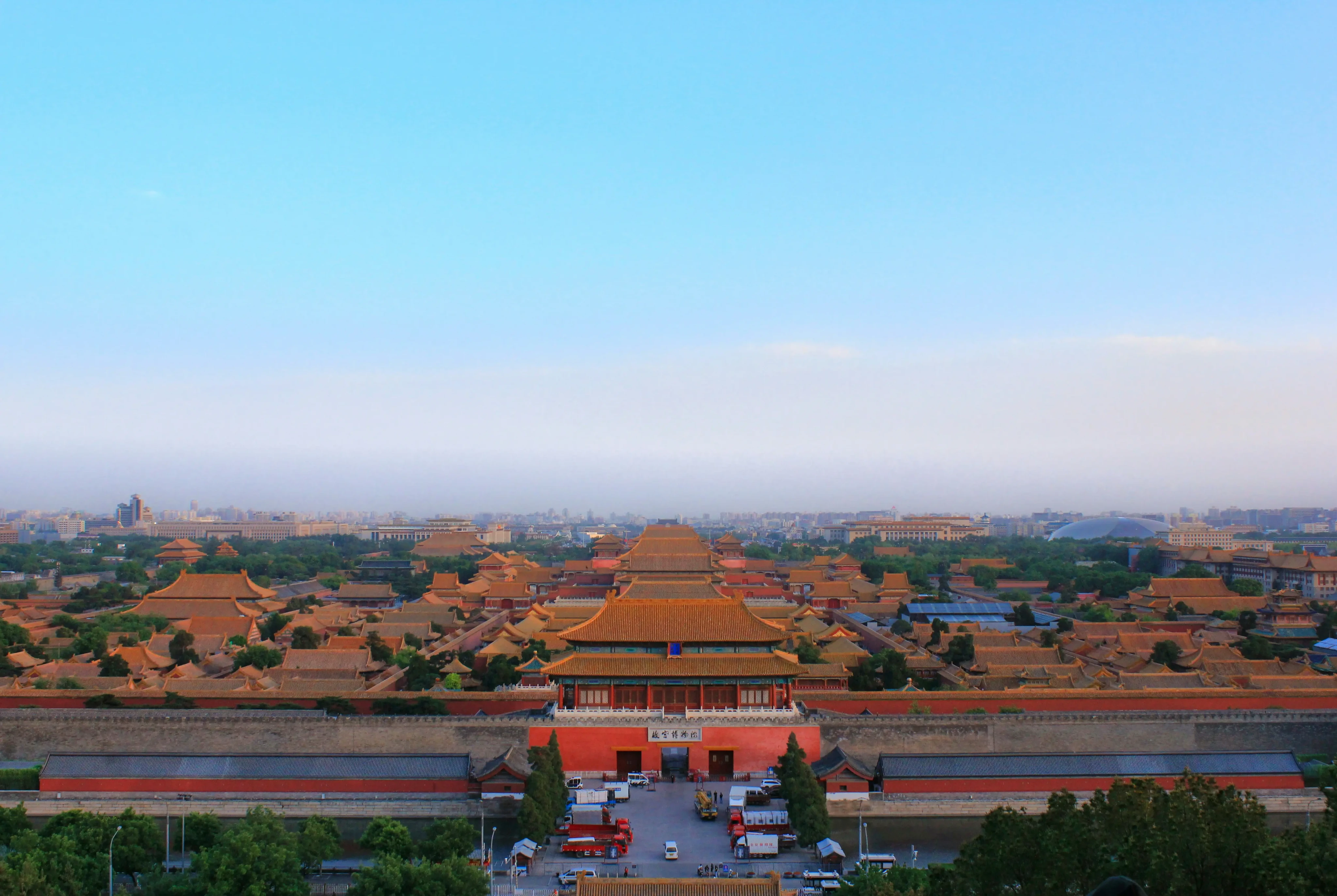
Forbidden City
Introduction
The Forbidden City (Chinese: 紫禁城; pinyin: Zǐjìnchéng), also known as the Palace Museum (故宫; Gùgōng), is the imperial palace complex located in the center of Beijing, China. It served as the home of Chinese emperors and the ceremonial and political center of Chinese government for nearly 500 years during the Ming and Qing dynasties. The Forbidden City is the world's largest preserved royal palace complex and the largest surviving wooden structure ancient building group.[1][2]
Historical Background
Construction and Imperial Era
The construction of the Forbidden City began in 1406 during the reign of the Yongle Emperor of the Ming dynasty and was completed in 1420. The massive project required more than one million workers, including over 100,000 skilled artisans, making it one of the most ambitious construction projects in ancient China.[1][3]
The palace served as the residence and administrative center for 24 emperors—14 from the Ming dynasty (1368-1644) and 10 from the Qing dynasty (1644-1912). For almost five centuries, from 1420 to 1924, the Forbidden City was the heart of Chinese imperial power and the center of political authority in China.
Modern Transformation
In 1925, following the abdication of Puyi, the last Emperor of China, the Forbidden City was converted into the Palace Museum and opened to the public.[1] In 1987, UNESCO designated the Forbidden City as a World Heritage Site, recognizing it as part of the "Imperial Palaces of the Ming and Qing Dynasties in Beijing and Shenyang."[4] This designation acknowledges its outstanding universal value as a masterpiece of Chinese palatial architecture and its significant role in the development of Chinese architectural and cultural traditions.
Architectural Features
Scale and Layout
The Forbidden City covers an area of approximately 720,000 square meters (178 acres), measuring 961 meters from north to south and 753 meters from east to west. It comprises 980 surviving buildings with 8,886 rooms.[1][2] The entire palace complex is surrounded by a 10-meter-high wall stretching 3,400 meters in length, with a 52-meter-wide moat encircling it. At each of the four corners stands an exquisitely designed corner tower, showcasing the sophisticated engineering and aesthetic achievements of ancient Chinese architecture.
The palace strictly adheres to the traditional Chinese urban planning principle of "qian chao hou qin, zuo zu you she" (前朝后寝,左祖右社), meaning "court in front, residence behind, ancestral temple to the left, altar to the right."[5][6] The entire complex is organized along a central north-south axis, with buildings symmetrically arranged on both sides. This axis extends from the Meridian Gate in the south to the Gate of Divine Might in the north, and further connects with Tiananmen Square to the south and the Drum and Bell Towers to the north, forming the central axis of Beijing.
Architectural Divisions
The Forbidden City is divided into two main sections:
Outer Court (前朝): Located in the southern section, this area was used for ceremonial purposes and state affairs. The core buildings are the Three Great Halls: the Hall of Supreme Harmony (Taihe Dian), the Hall of Central Harmony (Zhonghe Dian), and the Hall of Preserving Harmony (Baohe Dian). The Hall of Supreme Harmony, the largest surviving wooden structure in China, rises approximately 30 meters high and features the highest-ranking double-eaved hip roof covered with yellow glazed tiles.[1][7]
Inner Court (内廷): Located in the northern section, this area served as the residential quarters for the emperor and his family. The main structures include the Three Back Palaces: the Palace of Heavenly Purity (Qianqing Gong), the Hall of Union (Jiaotai Dian), and the Palace of Earthly Tranquility (Kunning Gong), complemented by the Six Eastern Palaces and Six Western Palaces. The naming and arrangement of these buildings reflect traditional Chinese philosophical concepts of yin and yang, the five elements, and the pursuit of harmony (zhong he).[2][8]
Cultural Symbolism
The architectural design of the Forbidden City embodies profound Chinese traditional culture:
Celestial Correspondence: The overall layout mirrors the three celestial enclosures (Ziwei Yuan, Taiwei Yuan, and Tianshi Yuan) in Chinese astronomy, reflecting the cosmological concept of "unity of heaven and humanity."[5][7]
Harmony Philosophy: From the naming of the Three Great Halls to the layout of the Three Back Palaces, the design consistently embodies the philosophical pursuit of maintaining equilibrium and achieving harmony (zhi zhong he), a core concept in Confucian thought.[2]
Color Symbolism: The yellow glazed tiles represent imperial supremacy, while the red walls symbolize majesty and auspiciousness. This color scheme creates an atmosphere that is both solemn and magnificent.[6]
North-South Integration: The architectural techniques represent a synthesis of craftsmanship from both northern and southern China. The participation of southern artisans, particularly the renowned "Xiangshan Bang" (香山帮) craftsmen from Suzhou, gave the Forbidden City's architecture its distinctive artistic style.[2]
Cultural Significance
The Forbidden City stands as a paramount carrier of over 5,000 years of Chinese civilization and represents the culmination of traditional Chinese official architecture (guan shi jian zhu).[2] It not only showcases the court culture and ritual systems of the Ming and Qing dynasties but also embodies the perfect synthesis of Chinese architectural art, craftsmanship, and aesthetic philosophy. As the world's largest preserved ancient wooden architectural complex, the Forbidden City has profoundly influenced architectural culture throughout East Asia.
Today, the Palace Museum houses a collection of over 1.86 million cultural artifacts, making it the world's most comprehensive repository of Chinese cultural treasures.[1] The museum receives more than 16 million visitors annually, establishing it as one of China's most important cultural landmarks. In 2018, the Forbidden City's market value was estimated at US$70 billion, making it both the world's most valuable palace and the most valuable piece of real estate globally.[1]
References
[1]: Wikipedia. "Forbidden City". <https://en.wikipedia.org/wiki/Forbidden_City> (Accessed December 2025)
[4]: UNESCO World Heritage Centre. "Imperial Palaces of the Ming and Qing Dynasties in Beijing and Shenyang". <https://whc.unesco.org/en/list/439> (Accessed December 2025)
[2]: Qiushi Journal. "紫禁城:中国古代宫殿建筑的集大成者 (The Forbidden City: The Culmination of Ancient Chinese Palatial Architecture)". <http://www.qstheory.cn/culture/2024-03/28/c_1130080629.htm> (March 2024)
[7]: CCTV News. "历史文化视野中的紫禁城建筑五问 (Five Questions about Forbidden City Architecture from a Historical and Cultural Perspective)". <http://news.cctv.com/2022/10/30/ARTIMPxoA3lHK4H94yFo3Cw6221030.shtml> (October 2022)
[5]: Guangming Daily. "细致品味故宫建筑文化 (Appreciating the Architectural Culture of the Forbidden City)". <https://news.gmw.cn/2023-04/06/content_36481253.htm> (April 2023)
[6]: China Culture. "故宫的皇家建筑风格 (The Imperial Architectural Style of the Forbidden City)". <https://chiculture.org.hk/tc/china-five-thousand-years/1330> (June 2022)
[3]: Xinhua News. "大成之城北京紫禁城的六百年 (The Grand City: Six Hundred Years of Beijing's Forbidden City)". <http://www.xinhuanet.com/politics/2020-10/16/c_1126619063.htm> (October 2020)
[8]: Xinhua News. "【文明之美看东方】从建筑之美到四时之景,故宫如此动人 (The Beauty of Civilization: From Architectural Splendor to Seasonal Scenery, the Forbidden City is Captivating)". <http://www.news.cn/culture/2022-07/25/c_1128862102.htm> (July 2022)