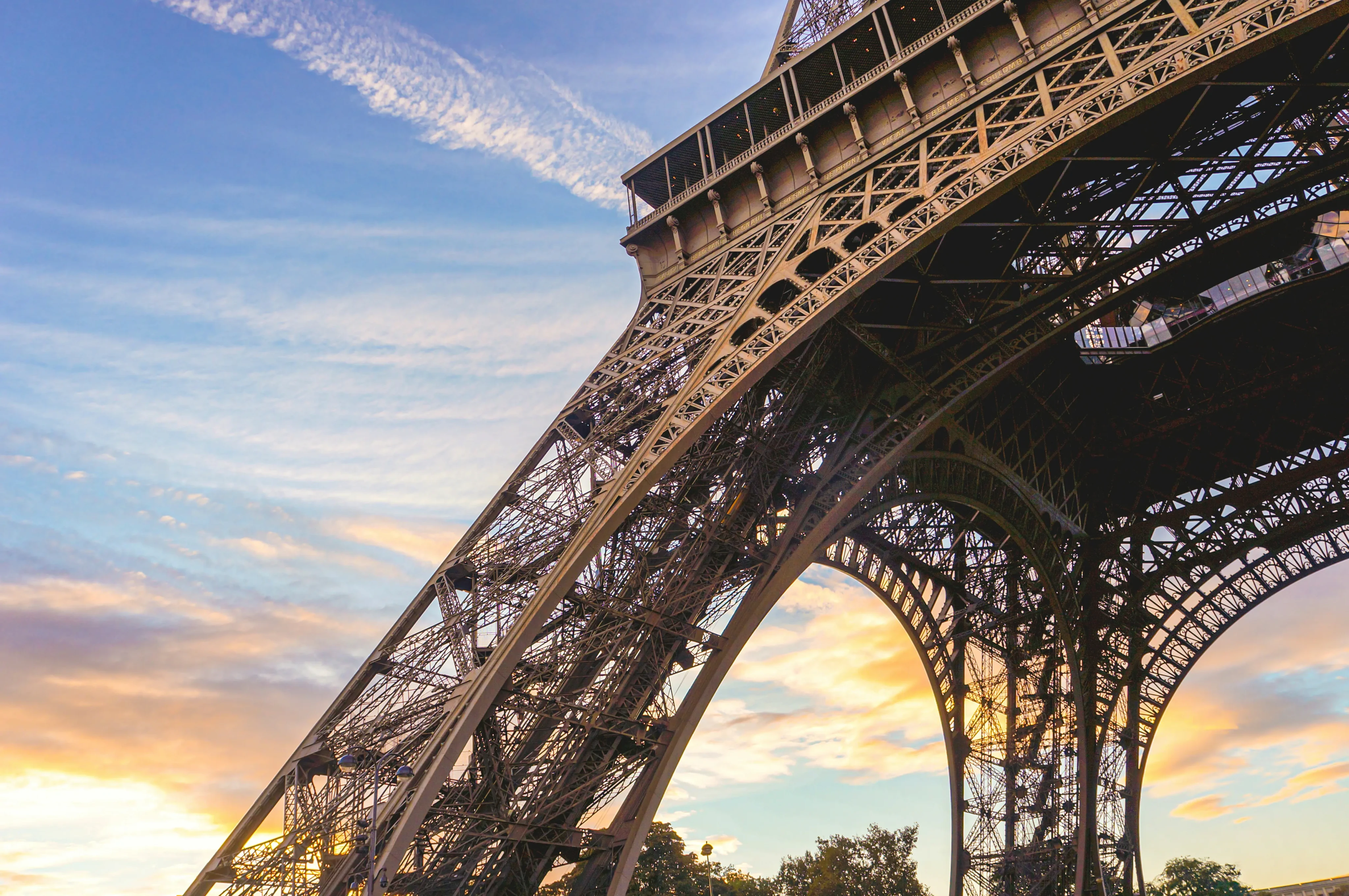
Eiffel Tower
Introduction
The Eiffel Tower (French: La Tour Eiffel) is a wrought-iron lattice tower located on the Champ de Mars in Paris, France. Built between 1887 and 1889 as the entrance arch for the 1889 World's Fair (Exposition Universelle), which celebrated the 100th anniversary of the French Revolution, the tower has become the most iconic symbol of Paris and one of the most recognizable structures in the world.[1][2]
Named after its designer, engineer Gustave Eiffel, the tower stands 330 meters (1,083 feet) tall and was the world's tallest man-made structure for 41 years until the Chrysler Building was completed in New York in 1930.[3][4]
Historical Background
Design and Planning
In 1886, a competition was held to design a monument for the 1889 Exposition Universelle. Gustave Eiffel's company, along with engineers Maurice Koechlin and Émile Nouguier and architect Stephen Sauvestre, submitted the winning design. The tower was intended to demonstrate French engineering prowess and to serve as a temporary structure that would be dismantled after 20 years.[3][5]
The design faced significant opposition from many Parisians, including prominent artists, writers, and intellectuals who considered it an eyesore that would mar the city's classical architecture. A petition signed by notable figures including Guy de Maupassant, Alexandre Dumas fils, and Charles Garnier protested the "useless and monstrous" tower.[2][1]
Construction
Construction began on January 28, 1887, and took just over two years to complete. The project demonstrated remarkable engineering precision and efficiency:[6][7]
Construction period: 2 years, 2 months, and 5 days (completed on March 31, 1889)
Workers: Approximately 300 workers
Components: 18,038 metallic parts held together by 2.5 million rivets
Weight: 10,100 tons (including 7,300 tons of metal framework)
Precision: Parts were manufactured at Eiffel's factory in Levallois-Perret with accuracy to a tenth of a millimeter
Safety: Remarkably, only one worker died during construction (not during work hours), an extraordinary safety record for the era[7][3]
The tower was inaugurated on March 31, 1889, and officially opened on May 6, 1889, during the World's Fair.[8]
From Temporary to Permanent
Initially intended to stand for only 20 years, the Eiffel Tower was scheduled for dismantling in 1909. However, it was saved due to its value as a radiotelegraph station. Eiffel had strategically placed antennas on the tower, and by 1900, it was being used for wireless telegraphy experiments. During World War I, the tower's radio intercepted enemy communications, proving its strategic military value.[2][1]
The tower's scientific and communications utility ensured its survival, and it eventually became the beloved icon it is today.[1]
Architectural Features
Structure and Design
The Eiffel Tower is an engineering marvel of 19th-century iron architecture:
Height:
Original height: 300 meters (984 feet)
Current height (with antennas): 330 meters (1,083 feet)
Base: Square base measuring 125 meters (410 feet) on each side
Levels: Three public levels accessible to visitors
Curvature: The tower's iconic curved shape is not merely aesthetic; it was mathematically calculated to provide maximum resistance to wind forces[4][3]
Innovative Engineering
Gustave Eiffel applied several innovative engineering principles:
Wind resistance: The open lattice structure allows wind to pass through, reducing wind load
Mathematical precision: Every component was designed using precise calculations to distribute weight and resist forces
Assembly method: Pre-fabricated parts were assembled on-site using temporary wooden scaffolding and steam-powered cranes
Foundation: Deep foundations were necessary on the Seine-side piers due to proximity to the river[7][3]
Three Levels
First level (57 meters/187 feet): Features exhibitions, a glass floor section, restaurants, and shops
Second level (115 meters/377 feet): Offers panoramic views and fine dining at the Jules Verne restaurant
Third level (276 meters/906 feet): The summit observation deck with Eiffel's private apartment (restored for visitors) and champagne bar[4][1]
Visitors can access the levels via elevators (installed in 1899) or by climbing 1,665 steps to the summit.[4]
Maintenance and Lighting
The tower requires constant maintenance:
Repainting: The tower is repainted every seven years, requiring 60 tons of paint to protect it from rust
Color: The tower's color has changed throughout history; it is currently painted in three shades of brown ("Eiffel Tower Brown"), darker at the bottom and lighter at the top to enhance its appearance against the sky
Lighting: The tower features 20,000 light bulbs that create a spectacular sparkling effect for five minutes every hour after sunset[1][4]
Cultural Significance
From initial controversy to universal acclaim, the Eiffel Tower has become one of the most beloved and recognizable monuments in the world. It symbolizes French innovation, engineering excellence, and the romantic spirit of Paris.[1]
The tower has played various roles throughout history:
Radio broadcasting: Essential for French radio and television transmission
Scientific research: Used for meteorological and astronomical observations, physics experiments, and studying air resistance
Tourism: The most-visited paid monument in the world, attracting approximately 7 million visitors annually
Cultural icon: Featured in countless films, photographs, artworks, and literature[1][2]
Today, the Eiffel Tower stands as a testament to human ingenuity and ambition, representing the transformative power of engineering and design. What was once derided as an eyesore has become the very symbol of Paris, embodying the city's elegance, romance, and cultural significance.[1][2]
References
[1]: Britannica. "Eiffel Tower." <558> (Accessed December 2025)
[2]: History.com. "Eiffel Tower." <559> (Accessed December 2025)
[3]: Britannica. "How Was the Eiffel Tower Built?" <560> (Accessed December 2025)
[5]: Tour Eiffel Official. "Origins and Construction of the Eiffel Tower." <561> (Accessed December 2025)
[8]: Eiffel Tower Paris Info. "History Eiffel Tower." <562> (Accessed December 2025)
[6]: Eiffel Tower Paris Tickets. "The Construction of the Eiffel Tower." <563> (Accessed December 2025)
[7]: Tour Eiffel Official. "The construction of the Eiffel Tower: an exemplary project!" <564> (Accessed December 2025)
[4]: Tour Eiffel Official. "The Eiffel Tower facts, height & weight." <565> (Accessed December 2025)