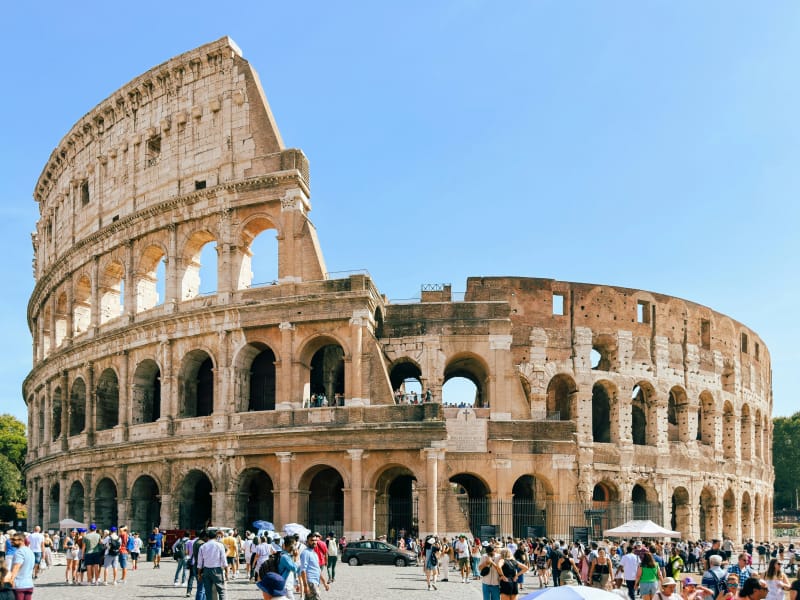
Colosseum
Introduction
The Colosseum (Italian: Colosseo), also known as the Flavian Amphitheatre (Latin: Amphitheatrum Flavium), is an iconic elliptical amphitheatre in the center of Rome, Italy. Built between 70-80 CE under the Flavian emperors Vespasian, Titus, and Domitian, it is the largest ancient amphitheatre ever built and remains the largest standing amphitheatre in the world today.[1][2]
In 1980, UNESCO designated the Colosseum, along with the Historic Centre of Rome, as a World Heritage Site. In 2007, it was voted one of the New Seven Wonders of the World, recognizing its status as one of the most iconic symbols of Imperial Rome and Roman civilization.[3][4]
Historical Background
Construction
Construction of the Colosseum began in 72 CE under Emperor Vespasian, the first of the Flavian dynasty, as a populist gesture to restore Rome and provide entertainment for its citizens. The site was chosen symbolically—it was built on the grounds of Emperor Nero's opulent palace, the Domus Aurea, which had been despised by Romans. By building a public monument on this site, Vespasian demonstrated the return of power to the people.[5][4]
The amphitheatre was completed in 80 CE under Vespasian's son, Emperor Titus, who celebrated the opening with 100 days of games, including gladiatorial contests and animal hunts. Further modifications were made under Titus's brother and successor, Domitian, who added the hypogeum (underground chambers) and additional seating levels.[2][3]
Roman Era Usage
For over 400 years, the Colosseum served as the premier venue for public spectacles in Rome, hosting:
It is estimated that hundreds of thousands of people and over a million wild animals died in Colosseum events during its active period.[1]
Medieval to Modern Era
The Colosseum's use as an entertainment venue ended in the early medieval period. Subsequently, it underwent various transformations:
Despite natural disasters (earthquakes in 847 and 1349), vandalism, and stone theft, much of the structure remains intact and stands as a testament to Roman engineering.[2]
Architectural Features
Structure and Dimensions
The Colosseum is an architectural marvel demonstrating the sophistication of Roman engineering:
- Length: 189 meters (615 feet)
- Width: 156 meters (512 feet)
- Height: 48 meters (157 feet) at its highest point
- Base area: 24,000 square meters (6 acres)
Architectural Orders
The external façade features four stories, with the first three displaying the progression of classical architectural orders:
This arrangement demonstrates the Roman mastery of Greek architectural styles and their systematic organization.[2]
Construction Innovation
The Colosseum showcases several engineering innovations:
Seating Arrangement
Seating was carefully organized by social class:
This hierarchical arrangement reflected the strict social stratification of Roman society.[2]
Cultural Significance
The Colosseum remains the most iconic symbol of Imperial Rome and is one of the most recognizable landmarks in the world. It represents the power, engineering prowess, and cultural sophistication of the Roman Empire at its zenith, while also serving as a reminder of the empire's brutal entertainment practices.[3]
As a UNESCO World Heritage Site and one of the New Seven Wonders of the World, the Colosseum attracts over 7 million visitors annually, making it one of the most visited tourist attractions globally. It continues to inspire architects, historians, and visitors from around the world.[7][2]
The monument has also become a symbol of the international campaign against capital punishment. Since 2000, the Colosseum has been illuminated in gold whenever a death sentence is commuted or a country abolishes capital punishment.[1]
The ancient Roman poet Venantius Fortunatus captured the Colosseum's enduring significance in the 8th century with the prophecy: "As long as the Colosseum stands, Rome will stand; when the Colosseum falls, Rome will fall; when Rome falls, the world will fall."[8]
References
[1]: Wikipedia. "Colosseum." <550> (Accessed December 2025)
[2]: Britannica. "Colosseum | Rome, Definition, Characteristics, History, & Facts." <551> (Accessed December 2025)
[3]: The Colosseum Rome. "The History of Colosseum: From Building to Present Day." <552> (Accessed December 2025)
[4]: Colosseo di Roma. "The History of the Colosseum." <553> (Accessed December 2025)
[5]: The Colosseum. "Explore the Architecture of the Colosseum (Design & Structure)." <554> (Accessed December 2025)
[6]: Colosseo Roma. "Architecture of the Colosseum." <555> (Accessed December 2025)
[7]: Colosseo di Roma. "Colosseum Rome." <556> (Accessed December 2025)
[8]: Il Colosseo. "The Colosseum." <557> (Accessed December 2025)